
By Alexandra O’Neil
ChatGPT Ads just took a significant step toward the tools performance marketers already rely on in Google Ads and Meta Ads. The platform recently rolled out conversion-optimized bidding, new mobile measurement integrations, and improved website attribution, alongside budget and campaign management upgrades. For small and medium-sized businesses weighing whether ChatGPT Ads deserves real budget, this update changes the game.
TL;DR: ChatGPT Ads just introduced conversion-optimized bidding, AppsFlyer and Adjust integrations for app tracking, and Automatic Advanced Matching for website conversions, giving advertisers a clearer answer to whether their ads are actually driving sales.
What New Measurement Tools Did ChatGPT Ads Just Launch?
The centerpiece of the update is conversion-optimized cost-per-click bidding (often called oCPC). Advertisers can now select a Conversions objective, and the platform automatically optimizes toward clicks most likely to lead to a conversion while still charging on a CPC basis.
Additionally, daily budgets are shifting to an average daily budget model over a rolling seven-day period, giving campaigns more flexibility to pace spend around fluctuating demand instead of hitting a hard daily ceiling. For those who already run ads on Meta and Google, this change will feel very familiar.
Product feed campaigns are picking up updated product cards with pricing and star ratings, and the Ads API now supports asynchronous bulk creation and updates for campaigns, ad groups, and ads, which matters most for agencies and larger advertisers managing high volumes of campaigns.
Why Does Better Attribution Matter For ChatGPT Ads?

Every new ad platform faces the same skepticism from business owners: can this prove it actually works?
Conversion optimization only functions as well as the data feeding it, and until now, ChatGPT Ads has had a thinner measurement layer than the platforms marketers were used to. This rollout makes sense, because like any emerging platform, optimizing features takes time. Since rolling out its ad capabilities earlier this year, ChatGPT has been navigating the complexities of building an attribution model from scratch. These new features are a great step in the right direction.
Most of this release focuses on foundational capabilities rather than new ad formats. Better conversion optimization, stronger attribution, and improved campaign management reduce friction for advertisers evaluating ChatGPT Ads alongside established platforms such as Google Ads and Meta Ads. In practical terms, that means a business running a campaign can really start to see which conversations, clicks, and interactions actually turned into leads or purchases, rather than relying on impressions and just hoping for the best. That visibility is what separates a media test from a true media investment, a gap explored further in our breakdown on how ChatGPT Ads work for advertisers.
What Do The New App And Website Tracking Integrations Actually Do?
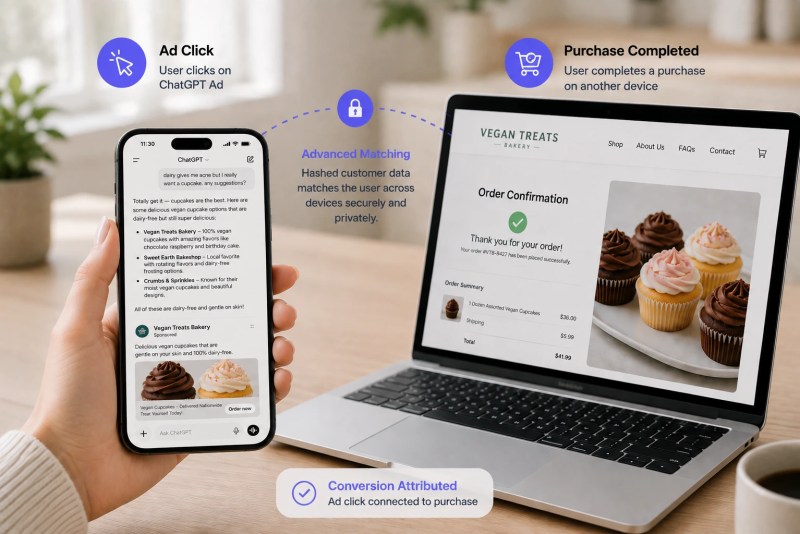
Two integrations stand out for advertisers trying to close the loop between ad spend and revenue. Integrations with AppsFlyer and Adjust let advertisers measure app installs and in-app events, which allows app-based businesses to run ChatGPT Ads with the same rigor they apply to app install campaigns on other platforms.
On the website side, Automatic Advanced Matching uses hashed customer data to improve website conversion attribution, and the feature can be enabled directly under Tools, Conversions, Data Source inside the Ads Manager.
Advanced Matching narrows the gap between an ad click and a completed purchase, even when a customer browses on one device and buys on another.
Should SMBs Start Testing ChatGPT Ads Now?
These updates finally give advertisers what they want: a way to focus on actual sales and leads, rather than just clicks. Being able to bid for real customers and accurately track where they came from is usually what turns a small test experiment into a permanent marketing budget. After all, business owners don’t want to pay for ads if they can’t prove they’re working, and these new tracking tools give ChatGPT Ads the exact proof businesses need.
Businesses considering the channel should treat it the way they would any new platform: start with a modest budget, confirm tracking is set up correctly through the new Advanced Matching and app integrations, and give the conversion data enough time to inform the bidding algorithm.
Despite being introduced several months ago, ChatGPT Ads still remains a newer entrant especially compared to platforms like Google and Meta. That said, ChatGPT’s conversion-tracking infrastructure is still building a track record. Pairing it with a broader strategy (rather than running it in isolation) tends to produce more reliable results.
Floodlight Helps SMBs Run ChatGPT Ads
Floodlight offers Programmatic Marketing services, including ChatGPT Ads, as part of a coordinated, omnichannel approach for small and medium-sized businesses. Our team monitors platform updates like this one closely, translating new measurement and bidding tools into campaigns that are set up correctly from day one and optimized as the data matures.
Interested in learning how ChatGPT Ads can help your business? Visit our ChatGPT Ads service page to see how the channel fits into a broader media plan.